|
|
Science of Golf Ball Flight
To see trajectory diagrams of different clubs, click HERE. December 13, 2008 - LiveScience.com recently published a video titled The Secret of Golf Balls Revealed: Dimple Dynamics. The video features an extensive simulation based on research conducted by scientists at Arizona State University and the University of Maryland looking at the effects of air drag on the dimples on a golf ball. Click on the graphic below.
Williams11 provided data on the carry and drive of a British golf ball hit with a driving machine. He did not cite the loft of the driver used but it has been assumed that it was a standard 10o commonly used at the time. He found that the carry of a golf ball depended linearly on the launch speed by the equation C = 1.5v -103, where v is the speed in ft/s and C is in yards. I varied the ball speed in my model (without sidespin or wind). My model replicated the linearity of the dependency with a similar equation, C = 1.45v
- 87.5 (see Appendix A). "Search for the Perfect Swing"10
explains and cites that an American ball (used in my model)
will carry 2-4% less than a British size ball. Comparison figures
are recorded in the table below.
On average, my model predicts the carry within 4 % of the Williams data. Since there was no recording of loft angle, launch angle, and atmospheric conditions, the reasons for the differences can only be speculated. It is difficult to find empirical data that has well documented conditions of launch. My model does predict, however, a linear dependency between launch speed and carry as determined by McPhee and Andrews8, MacDonald and Hanzely7 as well as most recently A.R. Penner12.
Visiball Golf Ball Finders
4 Different Lenses for: 1. Bright Light View Demo of how they help you find your lost golf balls.
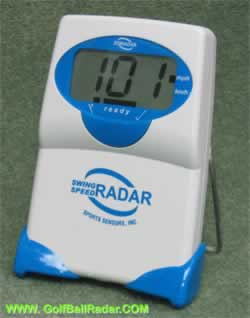
Power Meter measures Swing Speed
Using my model, I compared its predicted results
to the results of McPhee and Andrews because they investigated
the effects of sidespin (see Appendix B). The charts indicates
balls launched at 200 ft/s as an angle of 16 degrees with a
range of initial directions, on value of sidespin and cross
wind speed. Comparing the results of the two models, the flight
time difference is 0.3%, the range down the fairway difference
is 22.3%, and the lateral deflection to the right difference
is 4.5%. The range down the fairway is quite large because the
McPhee model is flawed. According to the empirical results of
Williams, a British ball launched at 200 ft/s at an angle of
10 degrees would carry 197 yards or 591 feet. An American ball
would fly about 2% less distance or about 579 feet. McPhee's
model predicts 588 feet, but when launched at an angle of 16
degrees. According to Erlichson4 and
A.R. Penner12 who investigated how a
golf ball's carry depends on the launch angle, the greater the
launch angle the greater the carry up to a maximum carry at
about 23. If one were to launch a ball at 200 ft/s at an angle
of 16 degrees, it would go significantly farther than one launched
at 10 degrees, thus the McPhee model predicts ranges down the
fairway which are too small. From "Iron Byron" (mechanical
robot the swings a club) tests which are reported by various
golf club companies, support the ranges predicted by my model.
For instance, Slazenger13 tested one
of their balls and found that its range when projected at about
8 degrees at a speed of 158 mph (70.2 m/s or 230 ft/s) was about
276 yards or 828 feet (again no atmospheric conditions reported,
but probably optimal, i.e. downwind).
My model does agree with McPhee model when
comparing flight times and lateral displacements (due to slicing
and wind). The spin and crosswind effects do not have a great
of an effect on the lateral or vertical displacement as they
do on the forward displacement because the forces are not as
significant in those directions. Thus various models would not
differ as much in those directions. The McPhee model, for instance,
assumed the aerodynamic forces depended on the ball speed, while
my model assumes the square of the ball speed as does the model
of MacDonald and Hanzely7 and A.R. Penner12.
As additional support for the accuracy of
my model, it can also model shots hit by all irons. Using spin
rates for iron shots cited by D.C. Winfield14
and G. Tavares, M. Sullivan & D. Nesbitt15,
my model also predicts the correct ranges of distances for iron
shots.
There is not much empirical data available
to quantify the effect that sidespin has on the golf ball. Companies
with robots, including the USGA, seem to keep the data a secret
unless paid large sums of money. Some golf club companies do
cite small amounts of data from testing they have done. One
such company is 13Adams Golf who has
tested and compared drivers of other companies with the clubface
2 degrees open. Their website has a picture of sliced drives
and cites "While the biggest names in golf, including the
CallawayT HawkeyeT and Taylor Made FiresoleT were all an average
18-31 yards off the centerline, the SC Series Driver ."
My model predicts that a driver hitting a ball at 72.4 m/s (260.6
km/h =162.9 mph=237.5 ft/s) at a trajectory of 8.5 degrees (very
typical conditions cited by companies) would carry 252.5 yards.
If the clubface were open 2o, the ball
would travel 245.6 yards down the fairway but would also travel
24 yards to the right. This amount of lateral displacement is
within the range cited my Adams Golf.
I have spent hundreds of hours developing
the model and the spreadsheet for predicting a golf ball trajectory.
I have researched the subject immensely, compared the model's
predictions to other experts' predictions and to empirical data.
I believe it is a fairly accurate model of the golf ball trajectory
and can be used with confidence.
My
Computer Model
 The equations
of motion used in my model are:
ax = -Bu(Cdux
- Cl(uz sin(a)
- uycos(a) )
ay = -g -Bu(Cduy
- Cluxcos(a) )
az = -Bu(Cduz
+ Clux sin(a))
as also
used by MacDonald and Hanzely7. Each
equation represents the acceleration of the golf ball in the
3 possible directions:
x = down the fairway (always positive)
y = vertically upwards (up is positive, down
is negative)
z = laterally sideways (right is positive,
left is negative)
B = a constant dependent on the conditions
of the air
u = relative velocity between the ball and
the air (i.e. wind)
Cd = coefficient of
drag which depends on the speed and spin of the ball
Cl = coefficient of
drag which depends on the speed and spin of the ball
a = the angle between the vertical and the
axis of rotation of the spinning ball
g = the acceleration due to gravity = 9.80
m/s2
Because the coefficients of drag and lift
change as the ball is in flight, solving the equations using
Calculus and the analysis of differential equations is too complex
if not impossible. Fortunately, very accurate approximations
can be made using a computer and a spreadsheet by calculating
the accelerations after very small periods of time have been
used. I used a time interval of 0.05 s. My predictions would
be more accurate if I used a smaller interval of time, but the
increase in accuracy would be much smaller than the inaccuracy
in the measured values of the coefficients of drag and lift
(for instance, a 0.05 interval predicts a maximum height of
35.8 m while a 0.01 s interval predicts 35.9 m, am 10 cm difference).
Accelerations, velocities and positions are
calculated every 0.05 s. Various parameters such as launch speed
and angle, wind, backspin, sidespin, etc., can all be varied.
One can change one quantity such as wind speed, and determine
how the wind in various directions can affect the end result.
1,2,3
Science and Golf I, II & III, Proceedings of the World Scientific
Congress of Golf, 1990, 1994, 1998, edited by A.J Cochran and
M.R. Farrally.
4
H. Erlichson, "Maximum projectile range with drag and lift,
with particular application to golf," Am. J. Phys. 51 (4),
357-361 (1983).
5
P.W. Bearman and J.K. Harvery, "Golf Ball Aerodynamics,"
Aeronaut, Q. 27, 112-122 (1976)
7
W.M. MacDonald and S. Hanzely, "The physics of the drive
in golf," Am. J. Phys 59 (3) 213-218 (1991).
8
J.J. McPhee and G.C. Andrews, "Effect of sidespin and wind
on projectile trajectory, with particular application to golf",
Am. J. Physics, Vol. 56, NO. 10, October 1988
9
A.J.Smits, "A new aerodynamic model of a golf ball in flight",
Science and Golf II: Proceedings of the World Scientific Congress
of Golf. Edited by A.J. Cochran and M.R. Farrally, 1994
10
A. Cochran and J. Stobbs, "The Search for the Perfect Swing,"
(Lippincott, New York, 1968)
7
W.M. MacDonald and S. Hanzely, "The physics of the drive
in golf," Am. J. Phys 59 (3) 213-218 (1991).
5
P.W. Bearman and J.K. Harvery, "Golf Ball Aerodynamics,"
Aeronaut, Q. 27, 112-122 (1976)
9
A.J.Smits, "A new aerodynamic model of a golf ball in flight",
Science and Golf II: Proceedings of the World Scientific Congress
of Golf. Edited by A.J. Cochran and M.R. Farrally, 1994
11
D. Williams, "Drag force on a ball in
Curriculum
Vitae: Expert's Qualifications
Ken Tannar,
601 Capri Road, Enderby, B.C. V0E 1V3, Canada
 Graduated
with a Bachelor of Science with majors in Physics and Mathematics
from the University of British Columbia, Vancouver Canada, in
1982.Have
been teaching Physics 11 (Intro to physics in Grade 11, 2nd
to last year or secondary school), Physics 12 (university preparation
in physics in Grade 12, graduating year from secondary school),
Calculus 12 (first year university/college Calculus) for the
past 18 years.Have
spent the last 5 years researching the literature on the topic
of Physics of Golf Graduated
with a Bachelor of Science with majors in Physics and Mathematics
from the University of British Columbia, Vancouver Canada, in
1982.Have
been teaching Physics 11 (Intro to physics in Grade 11, 2nd
to last year or secondary school), Physics 12 (university preparation
in physics in Grade 12, graduating year from secondary school),
Calculus 12 (first year university/college Calculus) for the
past 18 years.Have
spent the last 5 years researching the literature on the topic
of Physics of Golf (a
subtopic of the Physics of Sports or the Science of Sports).
Much of my research has centered on the organization called
the Scientific Congress of Golf, which holds a conference every
4 years at St. Andrews, Scotland
See Footnotes for a listing of the resources
I have used to do my research.
Designed
a website called ProbableGolf Instruction.com that provides
golfers with methods to improve their game without having to
do any physical practice. My ideas teach golfers to apply some
simple results of some very complex mathematics and physics
to my better club selections and decisions on the course. Much
of the information is provided for free, but golfers can purchase
other information and services on-line. The basis of the information
provided in the website are results of the research and development
I have done on the physics and mathematics of golf.I
have developed a computer spreadsheet that simulates the path
a golf ball travels through the air as well as the collision
between the various golf clubs and the golf ball. My model takes
into account variables such as clubhead speed, loft, ball speed,
initial trajectory angle, open, square or closed clubface, backspin,
sidespin, air temperature, humidity, density, etc. As will be
demonstrated later in this report, my model takes into account
the same variables as other researchers with comparable results.I
am a 1-handicap amateur golfer. I have been quite successful
competitively winning dozens of tournaments throughout British
Columbia. I have played in many B.C. Amateurs (one year I missed
making the Provincial Team by 1 shot) and 3 Canadian Amateurs.
Most recently I came 12th in the 2000
Canadian Champions of Club Champions sponsored by the Royal
Canadian Golf Association. I have been Club Champion for the
last 5 out of 7 years at the Salmon Arm Golf Club.
©Probable Golf Instruction, Ken Tannar 2001-2015. All Rights Reserved. Langley, B.C. V2Y 2G4 CanadaPhone: 604-309-7030 FAX: to fax, email an attachment probablegolf@yahoo.ca or golfexpert@probablegolfinstruction.com |


| GOLF ASSISTANTS |
|
Golf Trip Pairing CalculatorPlanning a golf trip with some friends/family? Trying to sort out the foursomes so people don't play too often with others? Order your ready made Spreadsheet. Type in the names, print out the groupings. Minimize repeat pairings.
Wind Caddy will advise you on aim, distance and club so that you can play the wind successfully. It takes the guess work out of club selection. New option to enter custom distances for each club. The algorithm will make a club suggestion accordingly. Use the right club in every condition!
|

|
|


| GOLF NEWS |
Golf Putting Green Reading Glasses |
| GOLF NEWSLETTER |
Statistics
·Putting
·Longest Golf Balls
·Games
·Handicap
·Scoring
·Shot Patterns
·Tournaments
·PGA Tour Stats
Pro Shop
·Ball Marker Engraved
·Books
·CDs & DVDs
·Green Reader
·Impact Labels
·Laser Rangefinder
·Longer Drives
·Products
·Teaching Aids
|
|
| GOLF POLL |
The 19th Hole
·Advertising
·Ask the Golf Expert
·Consultation/Litigation
·FAQs
·Golf Blog
·Golf Draws
·Links
·Science of Golf
·Tell a Friend
·Testimonials
·

Golf Ball Finder Glasses
Find all your errant golf balls and many more!
| GOLF TIPS |
How to play:
|