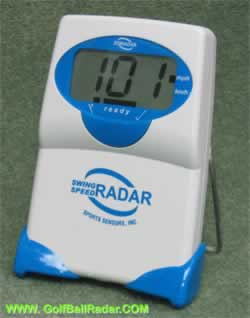
You can use the Swing Speed Radar to monitor and increase your swing speed. The Swing Tempo unit enables you to track and practice a consistent swing tempo.
Click on any of the following Newsletter topics or just scroll down the page:
Going away on a golf holiday with a group? Need a golf draw that pairs each player with each other player exactly once? or twice? or not at all? I have developed draws that meet those requirements. Take a look at them by CLICKING HERE, Golf Draws.
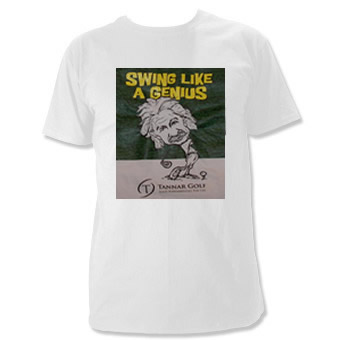
One Club Length, Different Lofts One length club, one set up, one swing, more consistency. Let the club do the work. Enter the code 10504 and receive a Special Bonus from them and a complimentary Golf Genius T-shirt from me.
For a short time, One Iron golf clubs will have free worldwide shipping. And, notify me of your purchase by email, and I'll send you a complimentary "Swing Like a Genius" T-shirt.
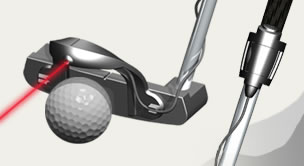
Misalignment of the putter face is the major reason most golfers putts start offline and miss the hole. An open putter face of only 2 degrees will result in missing a 15 foot putt by 0.5 feet.
Take a look at the Laser Putting Device that I use and consider getting one for yourself so that you can more consistently align the putter face along your target line.
Order yours TODAY! Only $49.95
Swing Speed Radar with Tempo Timer Measures Swing Speed and Tempo
Doppler Radar $149.95
Swing Speed Radar Measures Swing Speed
Doppler Radar $99.95
Tempo, Timing & Rhythm --
Backswing/Downswing Ratio
It's been determined that for the body to efficiently swing the golf club, there is an ideal Backswing/Downswing tempo ratio. John Novosel was one of the first to realize this after analyzing the tempos of many professional golfers. He found that all good professionals have a 3 to 1 ratio for Backswing/Downswing Tempos, meaning that the Backswing takes 3 times as long as the Downswing.
Although players swing with different total tempo times, the ratio is the same. Some take as short as 0.80 second from takeaway to impact, while others take as long as 1.20 seconds.
From a physics standpoint, the golf swing is a double pendulum motion, which involves a hinging of the wrists (also know as wrist cock). It is this double pendulum motion that creates the high club speed necessary to hit the golf ball a long ways.
Compare the double pendulum golf swing animation below left to Tiger's slow motion downswing. The animation repeats, so, start and stop Tiger's video at different stages. The animation runs more quickly than Tiger's slow motion swing.
There have also been quite a few biomechanics studies of the golf swing. One in particular, " Towards a Biomechanical Understanding of Tempo in the Golf Swing" by Grober and Cholewicki of Yale University found that a good model for the golf swing. They found:
" ... the tempo of the golf swing of professional golfers exhibits remarkable uniformity in 1) the absolute time scale, 2) the ratio of backswing time to downswing time and 3) the invariance of these times as a function of the length of the swing. These observations suggest that professional golfers have at the core of their golf swing a biomechanical clock."
They found that a realistic model for a golf swing is like a torsion spring with low stiffness being wound up and then released. The arms and club rotate around the body, as it coils. The body then uncoils pulling the arms and club with it.
Grober and Cholewicki confirmed from a theoretical biomechanical level, that for such a system to work efficiently, the backswing coil lasts about 3 times longer than the downswing coil. This confirms Novosel's findings.
In summary, Grober & Gholewicki found:
1. A system like the golfer swinging a club naturally will take about 0.75 seconds for the backswing, regardless of the length of the backswing.
2. The downswing of such a system will take about 0.25 seconds.
3. Thus the ratio of backswing to downswing is 3 to 1, regardless of the length of the swing.
Sorry, regardless of the club you're swinging or the length of the swing, the swing tempo and ratio should be the same, Driver through half wedge through putter. A putting stroke obviously covers much less distance, but moves much more slowly in the same time.
As more evidence, review the information below from one of my earlier newsletters.
Take a look at this slow motion video of Tiger hitting an iron at the 2007 PGA. I grabbed a stopwatch and timed the various parts of the swing.
In slow motion (thus time measured will be much longer than real time), here are the times for Tiger:
From takeaway to impact = 21.4
Transition Period = 6.6
I measured the transition period to be from when Tiger's hands are level with his head from backswing to downswing.
The ratio of his transition period to total (backswing-forwardswing) is 6.6 to 21.4 which is about 30%. He spends almost 1/3 of the time changing direction at the top of the swing.
Likewise, take a look at Tom Watson's swing.
From takeaway to impact = 9.7
Transition Period = 3.5
Note that the times for Watson's are shorter due to the slow motion video being at a different rate. The ratio of his transition period to total is 3.5 to 9.7 which is about 36%, again measuring his hands from level with his head.
Usually, when a player begins to hit the ball more poorly than normal, it's because they disrupt tempo ratio of Backswing/Downswing, usually getting a little quick during the transition phase. Their rhythm is off along with the timing of the proper sequences of the downswing.
You'll find that the audio tracks offered by Tour Tempo below will help you get back on track quickly. It's kind of like practicing the play of a musical instrument using a metronome to help with the timing and the rhythm. Finding your Golden Ratio Tempo will automatically improve your rhythm and timing.
Have you ever heard the tip "wait for the club at the top of the swing"? This tip is referring to taking enough time during the transition period to change the direction of the club. You must do so slowly, so that the large muscles of the body have time to lead the downswing.
You'll here a lot about accelerating through the ball in golf instruction. Often, golfers are told that decelerating through a shot will spell disaster.
Firstly, from a physics point of view, it's virtually impossible to for the club to be decelerating just before impact. If you have any kind of delay of the wrists uncocking, the club will be accelerating through impact.
Take a look at this video I made of a swinging club. I made a two lever swing system to simulate an arm swinging a golf club. One lever is the mass of an average arm and the other lever is the mass of an average club shaft with clubhead at its end. The two are connected by a freely rotating hinge.
As the arm/club system is released, it falls only due to gravity. Watch how the delay angle between and arm and club is maintained naturally until the bottom of the swing. At that point, the arm slows down and the club speeds up.
Just like with your golf swing, the club will lag the hands on the way down. Unlike the "pure gravity" situation like the video above, you will be exerting forces on the club as you swing. The club will accelerate from the top of the swing. What's important, is that the acceleration be gradual, so the speed build up all the way down. This is where timing comes in.
I like to think of the downswing as a gradual build up of speed, such as a roller coaster smoothly going faster and faster down a hill, or, a person on a swing, swinging down from their highest point.
Take a look at this video of a fellow on a very long swing. His swing gets longer and longer as he pumps his body. This is the same as the golf arm swing, as you take a longer and longer swing. Watch the video right to the end. You'll see the pendulum at its highest point (like the highest point of the golfer's backswing). Watch as the transition between the backward motion and forward motion is very gradual (long transition time). The speed builds up very gradually on the way down, and maximizes at the bottom.
The only real difference with the golf swing is it has a second lever, the club. As the arms swing down, the club lags behind and then catches up at the bottom. To review and learn more about this principle, see this previous newsletter where I compare the double pendulum swing with Tiger Woods'.
Will Tiger Win? Will Tiger Beat Nicklaus' Record?
Tiger's play recently has hinted that he's getting his game back. Will he be able to regain his form, get back into the winner's circle on a regular basis, and, challenge Jack Nicklaus' records?
Take a look at some comparisons of the two careers: Tiger Woods and Jack Nicklaus.
Jack Nicklaus actually had a similar drought of winnings at about the same time in his career as Tiger, although probably for different reasons, or, perhaps not ...... Perhaps such drought are a natural state of playing at such a high level.
In this year's newsletters, I'm going to include suggestions about the types of betting games you can play in this wonderful game. I find betting games serve 3 major purposes:
1. They promote a lot of fun and comradery, as long as the betting isn't too high.
2. When playing poorly, they provide some short term focus and additional motivation enabling one to turn things around.
3. When playing well, they provide yet another distraction to derail us. It's great practice to try blocking out these little nuances from ruining our games.
Game of the Month -- Acey-Deucy
The player (or players) with the lowest score on each hole gets paid a predetermined amount by the player (or players) with the highest score. For instance, let's say the four plays score net 3, 4, 6, 7 on a hole. The player with the 3 wins a point from the player with the 7. A point can be worth any predetermined value. If two players tie for lowest score, the player with the highest score pays each lower player one point. This game creates a real incentive to "not get a high score." It's important to play safe when in trouble.
Play Premium Golf Balls -- Used Ones
You know from past newsletters that I promote all golfers to play premium golf balls
Premium balls provide comparable distance (no significant loss, compared to those hard balls) along with maximum backspin required on those wedge and iron shots as well as great feel for chips and putts.
When's the last time you "found" a premium golf ball like a Titleist ProV1 or Nike ONE? Bet you were excited. Then, did you play with it and notice any significant loss in distance? Probably not.
In fact, most used golf balls perform just as well as brand new golf balls. Besides, when's the last time you played a full round with a new golf ball without losing it? Very few amateurs end up with the same ball they started with. Thus, most balls you find aren't even 1 round old.
The Golf Ball Testing company, GolfBallTest.org, conducted some very thorough tests on "high quality" second hand Water golf balls (balls found in water) and found:
1. NO significant difference in compression, weight, roundness or cover hardness, all tested with equipment similar to what the USGA uses.
2. NO significant difference in distance and amount of backspin, all tested with a robot launcher.
Golfers also involved in the testing just commented on the appearance of the balls (not as shiny and pure as a new ball). But, how many hits, trees, cart paths, before a new ball begins to look like a used ball.
There are a number of retailers out there that sell used golf balls. I'd stick with the highest grade used balls, although even the lower grades perform as well; they just aren't as nice cosmetically (which is the way the balls are graded in the first place).
So, stop by those kids that are selling used balls, or, perhaps the fellow on the side of the road. You can play premium balls for less than half the price. Click on the banner below to take a look at the offerings of a company I've affliated with.
1. Go to my Frequently Asked Questions (FAQ) page. There's a link to it on my pages from the left hand menu near the top of the page, just below the Search icon. It's called "FAQs." You then click on the graphic icon and you'll be taken to my database page. For your convenience, here it is: FAQ
I've answered hundreds of questions over the past 6 years and have created a fairly large database. You can search it out. If you can't find the answer you're looking for, submit a question and I'll answer it.
2. On all of my web pages, there is a search feature in the top left section, right underneath my LOGO. Just place your search keywords in the search box, select "This Site" below it, and then press "Search." What will come up is a Google search of the pages on my site with relevance. You can also search the entire internet by selecting "Web" instead.
Go to my main page now: Home or just check the top left menu of this page.
3. Also, directly under the Google Search area, you'll find a pop down menu called "Your Topic." Select the topic of interest and press "Go."
I would suggest you bookmark my main page and/or your specific areas of interest so that you can find them easily in the future. On each page at the very top, there is a link you can click on:
"Click here to add this page to your favourites"
Hope you find all you're looking for.
You can learn more from NEW Titleist Pro-V1 by clicking HERE.
A list of resources that have been used to produce
this newsletter can be found on my web site here.
Hope I provided some useful ways for you to
become better prepared for you best golf season
ever.
Ken Tannar
If
you are interested in receiving a newsletter dedicated
to the ideas of this site, use the form below to
subscribe.
Privacy Statement: We will not
use your mailing address for bulk mailings (spam). We
will send information you have requested only.
Furthermore, the frequency we will deliver the
information will be small (about one email message per
month). We will not pass your email address to third
parties under any circumstances.