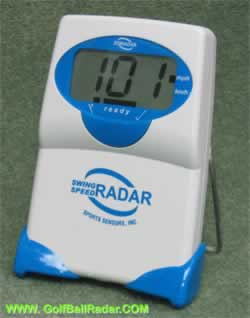
Happy New Year. I hope I can assist you, through my instruction, in making 2012 one of your best golf years ever. You can use the Swing Speed Radar to monitor your swing speed.
Click on any of the following Newsletter topics or just scroll down the page:
Going away on a golf holiday with a group? Need a golf draw that pairs each player with each other player exactly once? or twice? or not at all? I have developed draws that meet those requirements. Take a look at them by CLICKING HERE, Golf Draws.
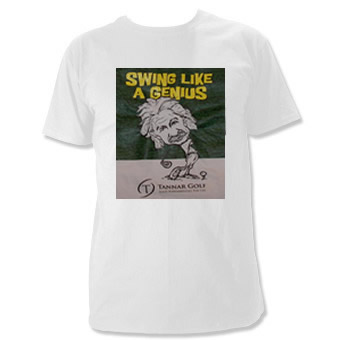
One Club Length, Different Lofts One length club, one set up, one swing, more consistency. Let the club do the work. Enter the code 10504 and receive a Special Bonus from them and a complimentary Golf Genius T-shirt from me.
For a short time, One Iron golf clubs will have free worldwide shipping. And, notify me of your purchase by email, and I'll send you a complimentary "Swing Like a Genius" T-shirt.
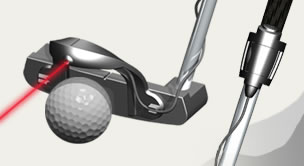
Misalignment of the putter face is the major reason most golfers putts start offline and miss the hole. An open putter face of only 2 degrees will result in missing a 15 foot putt by 0.5 feet.
Take a look at the Laser Putting Device that I use and consider getting one for yourself so that you can more consistently align the putter face along your target line.
Order yours TODAY! Only $49.95
Swing Speed Radar with Tempo Timer Measures Swing Speed and Tempo
Doppler Radar $149.95
Swing Speed Radar Measures Swing Speed
Doppler Radar $99.95
Can You Lose Weight Playing Golf?
How much energy to you burn playing golf? That energy can translate into calories of food that you have consumed. Obviously, you'll burn more calories if you walk, as opposed to riding a golf cart. Plus, the farther you walk, the more calories you'll burn (criss crossing fairways looking for balls). So, here's some science behind how many calories you can burn while playing golf.
Firstly, the golf swing.
Nesbit and Serrano's paper "Work and Power Analysis of the Golf Swing" was published in a 2005 Journal of Sports Science and Medicine. In the paper, they outlined a study of the 3D mechanics of the golf swing using an energy based apporach. They calculated the energy required to swing for 4 different golfer types. The energies are in the table below using units of Calories.
The human body is a type of machine. As a machine, it is not 100% efficient, which would mean requiring 1 Calorie of energy to do 1 Calorie of work. The human body is actually quite inefficient due to the amount of body heat generated due to normal metabolism and exercise. Efficiencies range from about 5% (average person) to 25% (a well conditioned athlete). If we assume an efficiency of 10% for golfers, the food energy required to do work can be calculated by dividing the work by 0.10. Thus, the calories "consumed" by the body to swing a golf club is tabulated in the 2nd row.
Golfer Type
Male Scratch
Male 5 Handicap
Male 13 Handicap
Female 18 Handicap
Work in Calories
0.35
0.34
0.26
0.21
Energy in Calories
3.5
3.4
2.6
2.1
Peak Power in Watts
3875
3005
2310
1720
The table above is for a full swing. A Male Scratch player would make approximately 36 full swings (3 on the 4 par 5s, 2 on the 10 par 4s and 1 on the par 3s) in an 18 hole round of golf. Of course, a player might hit a provisional ball a few times in a round (due to a potential lost ball) or need to hit extra full shots because of errant shots. Let's assume, therefore, that the Male Scratch would make 40 full swings, on average, during a round.
Thus, 40 swings at 3.5 Calories per swing equals 140 Calories. Not even equivalent to a chocolate bar.
A Male 13 Handicap would take more full swings, but would utitlize less energy per swing, as would the Female 18 Handicap.
In conclusion, one will not consume many calories by swinging a golf club in around of golf.
Secondly, walking.
So, what about walking. If you get online, you'll find a multitude of calculators that will tell you how many calories you'll burn during different types of activities. I'm not sure I would trust those, as I found some major discrepancies. All the calculators I found assume that the amount depends on the weight of the person. Recent scientific studies, however, refute this assumption.
Published in "The Journal of Experimental Biology", Peter Weyand of Southern Methodist University reported the results of his study of energy burned while walking on a flat surface. His subjects ranged from 5 to 32 years old, weighing between 35 to 195 pounds, from 3.5 to 6 feet tall. He had them walk as slow as 0.9 mph and as fast as 4.2 mph. He simulataneously measured the walkers' oxygen consumption and carbon dioxide production rates to obtain their total metabolic rate.
In analyzing the walkers' styles, he found that all moved n exactly the same way regardless of their height. Essentially, if you scaled a 5 year old up to 6 feet in height, the giant child would walk in exactly the same way as a 6 foot tall adult. So, large people are not more economical in the way they walk than smaller people. Weyland concluded that the energy burned per stride was basically the same for all subjects, regardless of their height or weight. Thus, short people tend to burn more calories while walking than tall people, for only the reason that they take more strides.
Weyland formulated an equation for energy burned to be: 2.7 Joules per stride per kg of mass. Since taller people have longer strides, they can travel further for the same amount of energy per kg of mass, thus, they are more economical walkers. Weyland and his team determined that the amount of energy per metre walked on a level surface to be approximately 3.8 times mass divided by height (actual = 3.80M/H^0.95).
Using this equation, a child with mass 15.9 kg (35 lb) and height 1.07 metre (3.5 ft) would burn 57 Joules per metre (0.0136 Calories per metre). On a 6500 yard golf course, one would walk about 7500 to 8000 yards (depends on distance between tee boxes and the amount of zig zagging on each hole (looking for errant balls). Let's assume 8000 yards which equates to 7340 metres. The child would use 7340 X 0.0136 Cal = 100 Calories.
A 88.7 kg (195 lb) adult with 6 ft height would burn 190 J/m (0.045 Cal/m). On the same course, this adult would use 7340 X 0.045 Cal = 332 Calories.
A 100 kg (220 lb) adult with a 6 ft height would burn 214 J/m (0.051 Cal/m) and thus would use 374 Calories, not that much more than the lighter adult.
So, on a level golf course, one can assume an average size male golfer would burn about 300 Calories. An above average male would burn closer to 400 Calories, while swinging burns about 140 Calories. Walking definitely makes a significant difference in calories burned.
If you play and hilly golf course, walking can make even a bigger difference. Let's say you play a course whose topography is up and down. Everytime you need to climb uphill, your body will do more work and thus burn more calories. If one assumes say 9 uphill climbs (half the holes) of 60 feet or about 20 metres. The change in gravitational potential energy, GPE = mgh (m = mass in kg, g = 9.80 and h = 20 m) = 17 385 Joules = 4.1 Calories of an 88.7 kg golfer. Assuming a 10% efficiency, the golfer would burn 41 Calories. For 9 such climbs, the total would be 370 Calories.
The heavier the golfer, the more calories will be burned for uphill climbs.
In summary, the calories burned during a round of golf for a 195 lb adult would be about:
Take a power cart and burn only 140 Calories for full swing shots
Walk a level golf course and burn an additional 332 Calories
Walk a hilly golf course and burn an additional 370 Calories
The heavier the golfer, the more calories burned, especially on hilly golf courses. Walking is a great way to burn calories along with the benefit of some good healthy exercise. I encourage you to walk as much as possible.
You'll here a lot about accelerating through the ball in golf instruction. Often, golfers are told that decelerating through a shot will spell disaster.
Firstly, from a physics point of view, it's virtually impossible to for the club to be decelerating just before impact. If you have any kind of delay of the wrists uncocking, the club will be accelerating through impact.
Take a look at this video I made of a swinging club. I made a two lever swing system to simulate an arm swinging a golf club. One lever is the mass of an average arm and the other lever is the mass of an average club shaft with clubhead at its end. The two are connected by a freely rotating hinge.
As the arm/club system is released, it falls only due to gravity. Watch how the delay angle between and arm and club is maintained naturally until the bottom of the swing. At that point, the arm slows down and the club speeds up.
Just like with your golf swing, the club will lag the hands on the way down. Unlike the "pure gravity" situation like the video above, you will be exerting forces on the club as you swing. The club will accelerate from the top of the swing. What's important, is that the acceleration be gradual, so the speed build up all the way down. This is where timing comes in.
I like to think of the downswing as a gradual build up of speed, such as a roller coaster smoothly going faster and faster down a hill, or, a person on a swing, swinging down from their highest point.
Take a look at this video of a fellow on a very long swing. His swing gets longer and longer as he pumps his body. This is the same as the golf arm swing, as you take a longer and longer swing. Watch the video right to the end. You'll see the pendulum at its highest point (like the highest point of the golfer's backswing). Watch as the transition between the backward motion and forward motion is very gradual (long transition time). The speed builds up very gradually on the way down, and maximizes at the bottom.
The only real difference with the golf swing is it has a second lever, the club. As the arms swing down, the club lags behind and then catches up at the bottom. To review and learn more about this principle, see this previous newsletter where I compare the double pendulum swing with Tiger Woods'.
Golf Swing Instruction -- How we learn
Recall the concept of wearing headphones while you sleep to learn new information? It's still science fiction ... as is learning new golf swing moves without a lot of practice.
Psychologists and Kinesiologists have made great strides in recent years understanding how we learn new things.
Since you first started to move you limbs as an infant, you have learned to move them with greater control.
Crawling and walking were some of the first “complex” motions you learned.
You then learned to run and do other sophisticated movements with your body.
Because of golf swing's complexity, the body must learn it in parts or stages, not all at once.
You may have heard of the term “muscle memory”; a motion must be “stored in muscle memory” to be automatic. In fact, muscles don't have memory; only the brain does.
The brain controls all motions of all muscles through electrical signals in the nervous system.
Millions of neurons in the brain “fire” signals to one another, leading to the muscles.
Human Brain
Two Neurons
The more efficient the sequence of firing between neurons becomes, the more efficient the muscular motion.
When first learning a motion, the neuron pathways are not efficient. The more often the motion is repeated correctly, the more efficient the firing between neurons becomes (automatic).
Think of some automatic motions that you perform like:
Breathing
Heart Beat
Blinking of eyes
These motions are totally automatic, although you can alter them for a limited time.
Think of some automatic motions that you perform like:
Walking
Running
Dressing
These motions are not automatic, although you perform them very well. They have been learned, through practice have more chances, and, you won't make as many large numbers in the process.
The challenge in learning the golf swing, is to program the neurons of your brain to fire in the proper sequence, efficiently. This requires repetition and practice.
Kinesiology scientists believe it takes:
About 100 repetitions for a neuron pathway to be created
About 3000 to 5000 repetitions for mastery (to become automatic).
That's a lot of swings and practice.
There are multiple motions that must be mastered in a golf swing, many of them connected to one another.
The receptors in the diagram above are input sensors such as what would come from eyes, ears, fingers, etc. In order for the proper sequence of muscles to be fired as a reaction to the stimuli.
Once the neuron pathways are established and solidified (mastery), the brain will follow the proper sequence of signals to perform the task, automatically Just like you don't need to “think” about the proper sequence of motions in walking, the golf swing, although more complex, is the same. All that is needed is a conscious swing cue to begin, and the brain will tell the muscles how to do the rest.
We must practice enough so that the brain establishes an efficient sequence of neuron firing. An analogy would be learing the most efficient route to follow in getting from one point in a city to another (without the aid of GPS!).
Science tells us some important things about repetition. "It is a well known principle that learning is better when training trials are spaced out than when given all together," says Dr. Wayne Sossin , of McGill University in Montreal.
Sossin proved that spreading the production of the neuro-transmitter serotonin over five weeks of repetition leads to better learning than a tsunami of serotonin over a short time.
Other researchers, TJ Shors and her team at Rutgers University, have shown that the adult brain makes new neurons in substantial numbers -- between 5000 to 10000 a day. These cells are thought to be available to capture new learning – if such is presented to them. If not they die within two weeks.
Experiments at the National Institute of explain why practice and repetition are so important. There is a substance produced in the brain called myelin that acts as an insulator – it wraps around your neurons and prevents the electrical current that energizes your networks from leaking into the periphery.
Brains that have thick layers of myelin think and act faster. When Albert Einstein's brain was dissected they found glial cells in much higher concentration then in a normal brain and that was about the only difference between his brain and a normal one. Glial cells produce myelin.
When you repeat the same motion, it sends a signal down the pathway and it is that signal which prompts the brain cell to generate a wrap of myelin. Do this enough and you have yourself a neuro -template of how to repeat the motion – and the more you wrap it, the more efficient the performance.
Play Premium Golf Balls -- Used Ones
You know from past newsletters that I promote all golfers to play premium golf balls
Premium balls provide comparable distance (no significant loss, compared to those hard balls) along with maximum backspin required on those wedge and iron shots as well as great feel for chips and putts.
When's the last time you "found" a premium golf ball like a Titleist ProV1 or Nike ONE? Bet you were excited. Then, did you play with it and notice any significant loss in distance? Probably not.
In fact, most used golf balls perform just as well as brand new golf balls. Besides, when's the last time you played a full round with a new golf ball without losing it? Very few amateurs end up with the same ball they started with. Thus, most balls you find aren't even 1 round old.
The Golf Ball Testing company, GolfBallTest.org, conducted some very thorough tests on "high quality" second hand Water golf balls (balls found in water) and found:
1. NO significant difference in compression, weight, roundness or cover hardness, all tested with equipment similar to what the USGA uses.
2. NO significant difference in distance and amount of backspin, all tested with a robot launcher.
Golfers also involved in the testing just commented on the appearance of the balls (not as shiny and pure as a new ball). But, how many hits, trees, cart paths, before a new ball begins to look like a used ball.
There are a number of retailers out there that sell used golf balls. I'd stick with the highest grade used balls, although even the lower grades perform as well; they just aren't as nice cosmetically (which is the way the balls are graded in the first place).
So, stop by those kids that are selling used balls, or, perhaps the fellow on the side of the road. You can play premium balls for less than half the price. Click on the banner below to take a look at the offerings of a company I've affliated with.
1. Go to my Frequently Asked Questions (FAQ) page. There's a link to it on my pages from the left hand menu near the top of the page, just below the Search icon. It's called "FAQs." You then click on the graphic icon and you'll be taken to my database page. For your convenience, here it is: FAQ
I've answered hundreds of questions over the past 6 years and have created a fairly large database. You can search it out. If you can't find the answer you're looking for, submit a question and I'll answer it.
2. On all of my web pages, there is a search feature in the top left section, right underneath my LOGO. Just place your search keywords in the search box, select "This Site" below it, and then press "Search." What will come up is a Google search of the pages on my site with relevance. You can also search the entire internet by selecting "Web" instead.
Go to my main page now: Home or just check the top left menu of this page.
3. Also, directly under the Google Search area, you'll find a pop down menu called "Your Topic." Select the topic of interest and press "Go."
I would suggest you bookmark my main page and/or your specific areas of interest so that you can find them easily in the future. On each page at the very top, there is a link you can click on:
"Click here to add this page to your favourites"
Hope you find all you're looking for.
You can learn more from NEW Titleist Pro-V1 by clicking HERE.
A list of resources that have been used to produce
this newsletter can be found on my web site here.
Hope I provided some useful ways for you to
become better prepared for you best golf season
ever.
Ken Tannar
If
you are interested in receiving a newsletter dedicated
to the ideas of this site, use the form below to
subscribe.
Privacy Statement: We will not
use your mailing address for bulk mailings (spam). We
will send information you have requested only.
Furthermore, the frequency we will deliver the
information will be small (about one email message per
month). We will not pass your email address to third
parties under any circumstances.