June 27 /11
Click here to add this page to your favorites
Summer is now here with long days (Hours of Daylight Calculator) for more golf. I hope you can get out frequently. Mind the UV rays of the Sun, however (More why UV Intensity is so high now).
To help you with your scoring, I've got some great suggestions to help you with your club selection. Remember, one of the things I promote is improving without physical practice; that's playing smarter within your own capabilities. Of course, working on your swing a short game will also pay huge dividends, especially if you can gain a little more clubhead speed, as there is a high correlation between distance and low scores. You can use the Swing Speed Radar to monitor your swing speed.
Click on any of the following Newsletter topics or just scroll down the page:
Measuring Distance -- Yardage Markers and Rangefinders
Your Shot Pattern -- Know & Play Within Yours
Play Premimum Golf Balls -- Used ones cost less
Two Different Club Ranges -- Know yours!
Intermediate Focus Review these principles for better play in 2011.
Going away on a golf holiday with a group? Need a golf draw that pairs each player with each other player exactly once? or twice? or not at all? I have developed draws that meet those requirements. Take a look at them by CLICKING HERE, Golf Draws.
Are you playing a Driver with a Loft that gives you max distance?
Measuring Distance -- Yardage Markers and Rangefinders
In today's high tech world, it's much easier to determine accurate yardage for your shots via gps and rangefinders. One cannot depend solely on yardage markers or yardage signs as they don't take into account the position of tee boxes and the hole.
If you are using yardage markers found on the fairway (or 150 yard bushes), you need to be aware of how far left or right you are, as this affects distance to the hole. Take a look at this previous newsletter for more on this.
If you are using a laser rangefinder, just make sure you site the flag a few times to get your distance as you need to hold the device quite steady. You might actually be lasering an object behind the flag, which is farther away.
I use my Rangefinder for short wedge distances. I use a system of half-swing, 3/4 swing and choking down on the club for different distances 30 yards to 80 yards. It's very effective and consistent for distance control. You can find a description of my technique here: Wedge Distance Control
For some distances, I still use the "pacing method." I've practiced pacing to ensure each one of my paces is 1 yards (help that I have longer legs as well).
Now, if your shot is playing uphill or downhill or there is a wind blowing, you'll need to adjust appropriately for those factors. This isn't the topic of this newsletter, but can find more information at these links: WIND Yardage, Uphill or DownHill Yardage
Once you've determined your yardage, then comes the task of choosing the best club. As with most amateurs, my advice would be hit one more club, since you come up short over half the time. But, the more mathematical, scientific way is to select the club based on probabilities of past performance. Thus, the next topic.

Power Meter measures Swing Speed
Shot Pattern -- Know & Play Within Yours
What's your shot pattern with each club? By this, I don't mean just if you tend to hit it right or left, short or long, thin or fat. What percentage of the time do you do each of those? This "quantifies" your shot pattern so that it can be used mathematically to the greatest benefit.
Consider a typical shot pattern
below in Diagram
1, assuming a circular
green with the target
flag at the center.
This pattern represents
the player's last
27 shots with a particular
club. Note that most
of the shots fall
short of the middle
of the green and
are skewed to the
left. The bulk of
the misses are short
and left of the center
of the green. This
is consistent with
the fact that most
golfers hit short
of their targets.
Below right is a schematic of a
green in Diagram
2 bordered by water
front left and a
sand bunker on the right. We'll
also assume that
outside this diagram
is either out of
bounds or heavy foilage
of some sort (trees,
high grass, bushes,
etc).
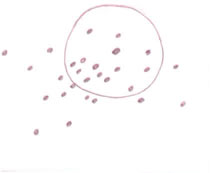 Diagram 1 |
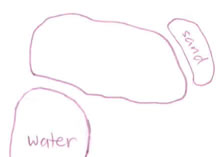 Diagram 2 |
Diagram 3 to the right is an overlap of the shot pattern with the green assuming the target is the flag at the left, front of the green.
Note that many of the shots would end up in the water or out of bounds. In fact, only 8 or 27 shots ends up on the green. |
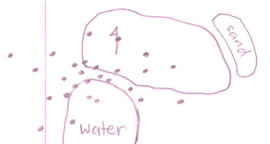 Diagram 3 |
In hitting to the above hole, what should the
player expect to
score if he/she aims
at the flag? We can
calculate the expected
score by using the
probabilities of
hitting different
positions. If you want the details on this, see this previous newsletter.
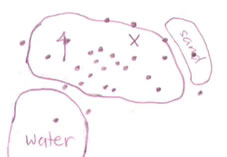
It should be quite obvious, however, that aiming at the flag is this situation will yield, on average, high scores. Many shots will end up in the water or out of bounds. It is advisable for this golfer to "play within his/her shot patterns" and aim further right and long, like in Diagram 4 below.
|
Note that 21 out of 27 shots hit the green. What a huge difference; that's 78%. Only 1 finds the water and 1 finds the sand.
|
Thus, I go back to my previous tip, hit one more club ..... and ...., aim away from the side your ball tends to gravitate. You could get more detailed and keep track of your own shot pattern with each club, but just following my simple tip will do wonders for your score.
You might argue that you'll rarely have chances for birdie by hitting long and towards other trouble, like a bunker. WRONG! Statistically, you'll actually have more chances, and, you won't make as many large numbers in the process.
 |
Developing consistent ball striking with a conventional set of irons is difficult as they have varying club lengths and lie angles. Thus, there are a multitude of different swing planes that the golfer must feel comfortable with to play consistently well.
Most golfers tend to have a favourite club. For most, it is a 7-iron. What's yours?
Each iron in a 1 Iron Set of Clubs has the same length, the same weight and the same lie angle. Thus, there is only ONE SWING! |
There is an old saying:
"Beware of the man with only one gun - he knows how to use it"
I've been playing with a set of 1 Iron clubs for 4 years now. I'll never turn back to a conventional set. Every club feels the same. I play the ball in the same position for all clubs. I hit all the irons the same distance as I did my old, conventional set.
If you're contemplating a new set of clubs this year, I'd highly recommend that you become "unconventional!" You only need one gun.
Play Premium Golf Balls -- Used Ones
You know from past newsletters that I promote all golfers to play premium golf balls
Premium balls provide comparable distance (no significant loss, compared to those hard balls) along with maximum backspin required on those wedge and iron shots as well as great feel for chips and putts.
When's the last time you "found" a premium golf ball like a Titleist ProV1 or Nike ONE? Bet you were excited. Then, did you play with it and notice any significant loss in distance? Probably not.
In fact, most used golf balls perform just as well as brand new golf balls. Besides, when's the last time you played a full round with a new golf ball without losing it? Very few amateurs end up with the same ball they started with. Thus, most balls you find aren't even 1 round old.
The Golf Ball Testing company, GolfBallTest.org, conducted some very thorough tests on "high quality" second hand Water golf balls (balls found in water) and found:
1. NO significant difference in compression, weight, roundness or cover hardness, all tested with equipment similar to what the USGA uses.
2. NO significant difference in distance and amount of backspin, all tested with a robot launcher.
Golfers also involved in the testing just commented on the appearance of the balls (not as shiny and pure as a new ball). But, how many hits, trees, cart paths, before a new ball begins to look like a used ball.
There are a number of retailers out there that sell used golf balls. I'd stick with the highest grade used balls, although even the lower grades perform as well; they just aren't as nice cosmetically (which is the way the balls are graded in the first place).
So, stop by those kids that are selling used balls, or, perhaps the fellow on the side of the road. You can play premium balls for less than half the price. Click on the banner below to take a look at the offerings of a company I've affliated with.

No shipping charges on orders over $75.
If you want some more details about a Golf Digest Study of Used Golf Balls in which they had Golf Laboratories use their Golf Robot to hit the balls, click on this link:

Trying to find answers on my website? Here's how.
1. Go to my Frequently Asked Questions (FAQ) page. There's a link to it on my pages from the left hand menu near the top of the page, just below the Search icon. It's called "FAQs." You then click on the graphic icon and you'll be taken to my database page. For your convenience, here it is:
FAQ
I've answered hundreds of questions over the past 6 years and have created a fairly large database. You can search it out. If you can't find the answer you're looking for, submit a question and I'll answer it.
2. On all of my web pages, there is a search feature in the top left section, right underneath my LOGO. Just place your search keywords in the search box, select "This Site" below it, and then press "Search." What will come up is a Google search of the pages on my site with relevance. You can also search the entire internet by selecting "Web" instead.
Go to my main page now: Home or just check the top left menu of this page.
3. Also, directly under the Google Search area, you'll find a pop down menu called "Your Topic." Select the topic of interest and press "Go."
I would suggest you bookmark my main page and/or your specific areas of interest so that you can find them easily in the future. On each page at the very top, there is a link you can click on:
"Click here to add this page to your favourites"
Hope you find all you're looking for.
You can learn more from NEW Titleist Pro-V1 by clicking HERE.
A list of resources that have been used to produce
this newsletter can be found on my web site here.
Hope I provided some useful ways for you to
become better prepared for you best golf season
ever.
Ken Tannar
If
you are interested in receiving a newsletter dedicated
to the ideas of this site, use the form below to
subscribe.
Privacy Statement: We will not
use your mailing address for bulk mailings (spam). We
will send information you have requested only.
Furthermore, the frequency we will deliver the
information will be small (about one email message per
month). We will not pass your email address to third
parties under any circumstances.
|