January 31 /11
Click here to add this page to your favorites
This is my first contact with you in a few months. The holiday season coupled with work on a few projects prevented me from getting a newsletter to you earlier. My apologies. Happy New Year, and I hope 2011 is one of your better ones.
Hope you're excited as I am. The days are beginning to get longer, and, those of us in the North could be back playing golf in a matter of 6-8 weeks. The Golf Show in Orlando is just wrapping up; the 2011 golf season has begun. You can work on your swing speed with the aid of the Swing Speed Radar or work on your putting with the Laser Putting System. Get one for yourself or for as a gift for someone else.
Download my wind tips by going to this page for more explanation. Or, if you have an iPhone or iPod, download my app below.
 |
Wind Caddy App
Wind Caddy helps the golfer always select the right club for the conditions. Wind Caddy works by collecting 4 inputs and recommending a club and correct Aim for the hole based on a proprietary algorithm developed by me.
Wind Caddy will advise you on aim, distance and club so that you can play the wind successfully. It takes the guess work out of club selection.
Click Here to Learn More .... |
Click on any of the following Newsletter topics or just scroll down the page:
You Have Two Different Club Ranges
How to Analyze Your Ball Flight to Correct Your Swing Path
New Club Technology -- Driver Head Weight
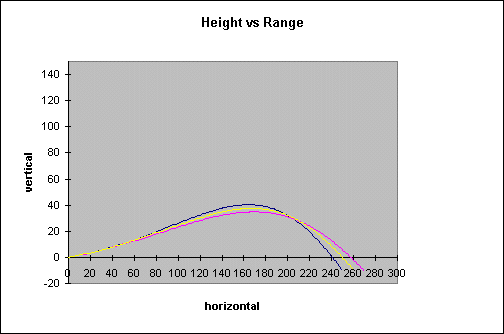
Golf Ball Trajectory Software
Intermediate Focus Review these principles before playing in 2011.
Going away on a golf holiday with a group? Need a golf draw that pairs each player with each other player exactly once? or twice? or not at all? I have developed draws that meet those requirements. Take a look at them by CLICKING HERE, Golf Draws.
Please provide me some feedback about my newsletter and future newsletters. What do you like? What would you like to see? Please complete this Golf Newsletter Feedback form.
Looking to do some serious putting practice? Remember improvement in putting can make the more improvement in score than any other part of the game. I found a really neat putting green system. Take a look below.


Two Different Club Ranges -- Know Yours!
As you are probably aware, you sometimes get into a "groove" in which your ball striking becomes better than your normal. You hit the ball off the sweetspot much more often, and, as a result, hit the ball a little further with all clubs. It's always nice to get an extra 3-6 yards with your Driver, but not necessarily with your other clubs, ......., unless you can adjust.
You'll make more putts, and thus score lower, when you start hitting the ball closer to the hole. When you do find the "groove," it's important to know your yardages so that you can take advantage of your excellent ball striking. I'm sure you've had the experience of "flushing" it off the club face, only to find you're hit it past the pin or over the green. Do this a few times, and then you start to second guess yourself. Self doubt can set in and then, you fall right out of the "groove."
So, I suggest you track your shots this season. Know yardages accurately, and record whether you achieved them or over-achieved them. Do this with all your clubs. Omit the really bad ones (like when you top or chunk them), but record as many as you can. Then, for each club, add the yardages together and divide by the number of shots. This will give you the average distance. You'll probably find that on average, you don't hit the ball as far as you thought.
On those occasions when you do get in the "groove," track your shots separately from the rest and calculate your averages again. Thus, you'll have two averages for each club: one distance average for when you're in the "groove," and one distance average for the rest of the time.
I've made a simple spreadsheet that will calculate these two averages for you. All you'd need to do is input the yardages. Email me if you'd like a copy.
How does a golfer get maximum distance from the Driver? Maximum distance depends on the following:
 |
Club Speed -- as high as possible. Click HERE to learn how to increase yours. |

|
Club Angle of Attack -- ideally one's club path must be upwards at the point of contact with the ball (swinging up on the ball). Swing upwards increases launch angle and increases carry distance. Most amateurs club path is downwards when hitting the Driver. Learn more HERE. See this graphic. |
|
Optimum Loft -- the optimum loft for the Driver depends on club speed and angle of attack. Most amateur's use Drivers with too little loft. Thus, they are better off using a 3-wood off the tee. Learn more HERE. |

|
Sweet Spot -- point of contact with the ball must be the sweet spot to get maximum energy transfer. Missing the sweet spot means less distance and errant shots. |
Please complete this Golf Newsletter Feedback form so that I can provide you with more great golf tips you're looking for in 2011.
Know Your Ball Flight to Know Your Swing Path
Through new Doppler Radar Technology, golf ball monitors like Trackman and Flightscope have immensely improved our understanding of swing path, club face angle and the resulting ball flight.
You're probably familiar with me saying over and over again that most golfers misalign their shots (right swingers misalign to the right, and left swingers misalign to the left). Your ball flight can tell you a lot about what the club is doing at impact.
It used to be that the "golf gurus" thought the initial direction of the ball is most greatly dependent upon the direction of the club swing path. Now, through Doppler Technology, we know that the club face has the most significant effect on initial ball direction.
In fact, the club face has about 85-90% effect. So, if you're a right swinger (about 90% of us), and your ball starts out to the right of your target, then your club face is open (angled to the right) at impact. A pull hook isn't necessarily the result of swinging outside-to-inside. It is most often the result on a closed club face.
One definite is that if your ball curves to the right (fade or slice), then the club face is open relative to your swing path. If your ball curves left (draw or hook), then the club face is closed relative to your swing path. Dave Tutleman does an excellent job of describing the effect on his site. Visit it for more detail.

If you slice the ball, it's because you're leaving the club face open at impact relative to your swing path. Often, this is a result of a poor grip. Of course, many slicers also "cut across the ball" and thus need to correct their swing path as well.
If you hook the ball, it's because the club face is closed at impact. This may be the result of releasing the club too early. Often, just changing your ball position (moving it back in your stance a bit), can go a long way towards reducing or eliminating the amount of hooks.
Anyhow, the intent of this article is to make you fully aware of how much the club face angle affects the initial golf ball direction as well as the resulting path.
New Technology -- Driver Head Weight
Clubhead weight (or more correctly, clubhead mass) is one of the key contributors to distance off the tee. The greater the mass of the clubhead and the great its speed, the farther the ball will go. Unfortunately, the greater the clubhead's mass, the slower will be its speed at impact. One can't swing a more massive (heavier) clubhead as fast. The physics of the interaction between club and ball is quite well understood. At play are the laws of momentum and energy. A given player (let's say you) is capable of swinging a club with a some maximum speed. The more massive the club, tthe slower will be this maximum speed. The speed of the ball is a result of the mass of the clubhead and its speed. So, as the mass increases, so will the resulting ball speed. But, since the clubhead is more massive, its maximum speed is less. There is actually an optimum mass for each golfer that produces the greatest ball speed. For most golfers, that mass is about 200 grams. A physics equation that determines the resulting ball speed is:
V = U*(1+e)/(1+m/M)
where U = clubhead speed, m = mass of ball, M = mass of clubheade is called the coefficient of restitution which is a measure of the efficiency of the kinetic energy transfer between club and ball. e has a value between 0 and 1. A collision with e=0 would be like a club hitting a putty ball, with the ball sticking to the club (maximum loss in kinetic energy). A collision with e=1 is called a perfectly elastic collision (no loss in kinetic energy). There would be no heat or sound produced at all, so of course is completely hypothetical.
In the past 15 to 20 years, club and ball manufacturers have made great leaps in increasing the e of the collision due mainly to the hollow, metal faced drivers whose faces can "spring back" upon collision. So much so that the USGA has put in place a legal maximum which is about 0.83. Club testers have found that e decreases with increased clubhead speed. Tiger Woods' drives, therefore, are not as efficient as yours or mine. He makes up for this by having significantly more clubhead speed. Let's take the example that your clubhead speed is 110 mph (48.9 m/s), which means you are a relatively long hitter. A typical value of e (exact value depends on the club) would be about 0.83. According to the equation above, the resulting ball speed (assuming a solid hit) would be: V = 110*(1+0.83)/(1+46/190) = 110*1.47 = 162 mph
assuming a 190 g clubhead hitting a 46 gram ball. The ball speed ends up being
1.47 times the original clubhead speed. Let's assume the amount of energy you can deliver to the club is same no matter what the mass of the club. Light clubs would have high speed, heavy clubs would have low speed, but the kinetic energy of the club would be the same in each case. The equation for kinetic energy is:
KE = 0.5*m*v*v = 0.5*0.19*48.9*48.9 = 227 Joules
where mass must be in kg and speed in m/s. In the table below are the resulting values for clubhead speed, e, and ball speed using different mass clubs, assuming constant kinetic energy of 227 Joules.
Club Mass (kg) |
Club Speed (mph) |
e |
Ball Speed (mph) |
Ball/Club Speed Ratio |
0.110 |
145 |
0.721 |
176 |
1.214 |
0.130 |
133 |
0.741 |
171 |
1.286 |
0.150 |
124 |
0.757 |
167 |
1.344 |
0.170 |
116 |
0.770 |
162 |
1.393 |
0.190 |
110 |
0.780 |
158 |
1.434 |
0.210 |
105 |
0.789 |
154 |
1.468 |
0.230 |
100 |
0.798 |
150 |
1.498 |
0.250 |
96 |
0.805 |
146 |
1.524 |
Note that it appears that the less the mass of the club, the greater the ball speed. The assumption made, however, is that the kinetic energy of the club is the same in all cases. Realistically, a golfer cannot obtain such speeds with light clubs. As determined by tests published in "Search for the Perfect Swing," the speeds of the clubs and the resulting ball speeds would be:
Club Mass (kg) |
Club Speed (mph) |
e |
Ball Speed (mph) |
Ball/Club Speed Ratio |
0.110 |
117 |
0.769 |
146 |
1.247 |
0.130 |
116 |
0.770 |
152 |
1.307 |
0.150 |
114 |
0.774 |
155 |
1.358 |
0.170 |
111 |
0.779 |
155 |
1.400 |
0.190 |
109 |
0.783 |
156 |
1.435 |
0.210 |
107 |
0.786 |
157 |
1.465 |
0.230 |
104 |
0.791 |
155 |
1.493 |
0.250 |
102 |
0.793 |
154 |
1.514 |
Ball speed actually peaks when using a clubhead with mass 0.210 kg or 210 g. This result is for a kinetic energy of 227 Joules. Different players with different swings and strengths would all have a slightly different optimum clubhead mass. For most, it is around 200 g, thus most drivers have clubhead masses that correspond to this. For most, experimenting to find the optimum mass would not yield very many extra yards. And, it's not as simple as adding a little lead tape to the clubhead because that would also change the center of mass of the club and the relative stiffness of the shaft, both also determiners of distance (future topics). If you happen to be quite strong and fit, you might be able to swing more massive clubheads with greater energy, thus resulting in more distance. One can only experiment.
If you are serious about trying to optimize your distance through clubhead mass, go to a facility that has a club/ball monitor (one that measures clubhead speed, ball speed, trajectory, spin, etc). You can experiment with different clubhead masses and shafts to find the one that produces optimum ball speed, trajectory and spin (the effects of which will be discussed in a future newsletter).
Trying to find answers on my website? Here's how.
1. Go to my Frequently Asked Questions (FAQ) page. There's a link to it on my pages from the left hand menu near the top of the page, just below the Search icon. It's called "FAQs." You then click on the graphic icon and you'll be taken to my database page. For your convenience, here it is:
FAQ
I've answered hundreds of questions over the past 6 years and have created a fairly large database. You can search it out. If you can't find the answer you're looking for, submit a question and I'll answer it.
2. On all of my web pages, there is a search feature in the top left section, right underneath my LOGO. Just place your search keywords in the search box, select "This Site" below it, and then press "Search." What will come up is a Google search of the pages on my site with relevance. You can also search the entire internet by selecting "Web" instead.
Go to my main page now: Home or just check the top left menu of this page.
3. Also, directly under the Google Search area, you'll find a pop down menu called "Your Topic." Select the topic of interest and press "Go."
I would suggest you bookmark my main page and/or your specific areas of interest so that you can find them easily in the future. On each page at the very top, there is a link you can click on:
"Click here to add this page to your favourites"
Hope you find all you're looking for.
You can learn more from NEW Titleist Pro-V1 by clicking HERE.
A list of resources that have been used to produce
this newsletter can be found on my web site here.
Hope I provided some useful ways for you to
become better prepared for you best golf season
ever.
Ken Tannar
If
you are interested in receiving a newsletter dedicated
to the ideas of this site, use the form below to
subscribe.
Privacy Statement: We will not
use your mailing address for bulk mailings (spam). We
will send information you have requested only.
Furthermore, the frequency we will deliver the
information will be small (about one email message per
month). We will not pass your email address to third
parties under any circumstances.
|