The Physics of BrushTees
The USGA has determined
that
"Brush" Golf Tees are allowable under
the rules of golf.

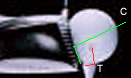
The green lines marked, C, are forces exerted by the club on the ball. The longest is what gives the ball its launch speed. The shorter green line is the frictional force of the club on the ball that causes backspin (counter-clockwise spin).
The red lines marked, T, represent the forces exerted on the ball by the tee, which are much smaller yet still significant. The longest red line is the force the tee pushes up on the ball as the ball lifts up out of the hollow of the tee. It causes a slightly higher initial trajectory and decreases the ball's speed. the smaller red line is the force of friction as the ball begins to slide across the edge of the tee. This force causes topspin (clockwise spin).
The larger the T forces are, the greater the effect on the ball. The Brush Tee has many flexible bristles that flex when forced and thus the forces on the ball are significantly smaller. Even though the tee only slows the ball slightly, it's enough to make a big difference in distance.
Take a long hitter with a clubhead speed of 119 mph. With a 10 degree
loft driver, the ball speed would be 163 mph with an initial trajectory
of
8.5 degrees and backspin of 3700 rpm. This assumes the only forces
acting on it are due to the club. The result would be a ball that flies
256 yd and rolls 28 yards for a total of 284 yards (assuming a warm
dry summer day).
The tee will exert forces that will decrease the ball speed and backspin
and increase the trajectory angle. Even if the tee reduced the ball
speed and backspin by 2% and increases the trajectory angle 2% (thus
the inital conditions would be 160 mph, 3600 rpm and 8.7 degrees),
the results would be 250 carry and 28 yards roll for a total of 278
yards;
that's 6 yards less, a 2.1% decrease.
The perfect tee would have no resistance at all.
Order yours TODAY! Only $5.95 per pair.
2CheckOut.com Inc. (Ohio, USA) is an authorized retailer for
goods and services provided by Probable Golf Instruction.
Probable Golf Instruction is a distributor of this product.